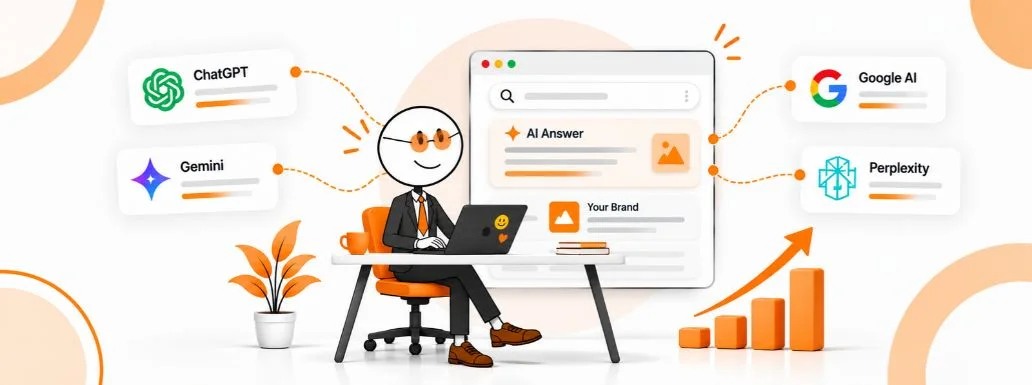
To use AI in SEO, give it data-heavy work, such as keyword clustering, content briefs, title and meta description drafts, schema, crawl analysis and keep people in charge of strategy, facts and final edit. That split gives you speed without costly mistakes.
AI SEO also means getting your business cited in AI search, where audience is now huge. Google says AI Overviews has more than 2.5 billion monthly users. Below, you will find the SEO tasks AI does well, prompts you can copy, AI for technical SEO and agents, best tools, how to get cited, local SEO tips and how to measure results.
Key takeaways
- AI SEO means two jobs. One is using AI to do SEO work faster. The other is optimising your site so AI search tools cite and recommend you.
- AI is best at research and first drafts. Keyword clustering, briefs, schema, meta descriptions and crawl analysis are good fits. Strategy, facts and final copy still need a person.
- Google doesn’t penalise AI-assisted content. It acts against pages mass-produced without adding value, which its policies call scaled content abuse.
- There is no secret AI markup. Google says you don’t need llms.txt, special schema or AI text files to appear in its AI features. SEO fundamentals still decide.
- Clicks are lower when an AI answer appears, but being cited helps. Seer Interactive found brands cited in an AI Overview earned more than twice the organic click-through rate of brands that weren’t.
- Measure it properly. Use Search Console’s generative AI report, GA4’s AI Assistant channel and a fixed list of prompts you check every month.
What is AI SEO?
AI SEO is use of artificial intelligence to plan, run and improve search engine optimization, together with work of making your content visible in AI-generated answers. Most teams now do both at once, so it helps to keep them separate in your head.
| AI for SEO | SEO for AI search | |
| Goal | Do SEO work faster and at larger scale | Get mentioned and cited in AI answers |
| Typical tasks | Keyword clustering, briefs, drafts, on-page fixes, crawl analysis | Clear answers, sourced facts, brand mentions, AI visibility tracking |
| Where results show | Google rankings, organic traffic, leads | AI Overviews, AI Mode, ChatGPT, Gemini, Perplexity |
| Main measure | Rankings, clicks, conversions | Citations, mentions, AI impressions |
You will see second job called generative engine optimisation (GEO), answer engine optimisation (AEO) or LLM optimisation (LLMO). Google doesn’t treat it as a separate discipline. Its own guide says SEO best practices continue to be relevant because its AI features are built on its core ranking and quality systems. Danny Sullivan, a director in Google Search, put it more bluntly at WordCamp US: “Good SEO is good GEO.”
Why AI matters for SEO right now
AI answers now sit on top of the search results for a large share of searches and they change how many people click. Here’s what the most reliable studies show.
| Finding | Source |
| AI Overviews has over 2.5 billion monthly users; AI Mode passed 1 billion (May 2026) | Google I/O 2026 |
| ChatGPT reached 900 million weekly active users (February 2026) | TechCrunch |
| People clicked a regular result on 8% of visits when an AI summary appeared, versus 15% without one, and clicked a link inside the summary on just 1% | Pew Research Center (900 US adults, 68,879 searches) |
| An AI Overview correlates with about 58% lower click-through rate for the number-one result (December 2025) | Ahrefs (300,000 keywords) |
| Organic CTR on AI Overview queries fell to 1.31% in December 2025, then recovered to 2.36% in February 2026 | Seer Interactive (5.47 million queries, 53 brands) |
| AI platforms send 0.32% of all website traffic, up from 0.02% in 2024; Google organic still sends about 134 times more visitors | SE Ranking (101,574 websites) |
Two things follow from this. First, Google is still where most of your search traffic comes from, so classic SEO is not optional. Second, fewer clicks reach websites from informational searches, which makes it more valuable to be sourced from AI answer names. Seer found that on informational queries, brands cited in an AI Overview had 2.07% organic CTR against 0.94% for brands that weren’t. The authors are clear that this is correlation, not proof of cause, since stronger brands are also more likely to be cited.
So is SEO dead? No. The job has widened, you now need to rank and you also need to be page AI systems trust enough to quote.
How to use AI in SEO: tasks it does well
Use AI where work is repetitive, follows patterns and is quick to check. A useful test, if a person can verify output in a few minutes, AI is probably a good fit. Most marketers already work this way. In Ahrefs’ 2026 survey of 301 marketers, 93% used AI to create or help create content and share using it for keyword clustering rose from 23% to 45% in a year.
| Task | What AI does well | What a person must check |
| Keyword research and clustering | Groups hundreds of keywords by intent and topic; suggests long-tail, conversational questions | Real search volume and difficulty; whether each cluster matches what you sell |
| Content briefs and outlines | Turns top-ranking pages into headings, questions and facts to cover | That the brief adds something competitors don’t have |
| First drafts | Fast structure and plain explanations | Every fact, number and claim; your own examples and opinions |
| Title tags, meta descriptions, headings | Many variations in seconds, within character limits | Accuracy, and that the snippet matches the page |
| Internal linking | Spots pages that should link to each other | That the anchor text makes sense to a reader |
| Schema markup | Drafts JSON-LD for articles, FAQs, products and local businesses | It validates in the Rich Results Test and matches visible content |
| Search data analysis | Finds falling pages, rising queries and CTR outliers in Search Console and GA4 exports | That the conclusion holds in the raw data |
| Link building research | Summarises competitor backlink gaps and drafts personalised outreach | Each site is relevant and genuine |
AI keyword research
Ask AI for clusters, not long lists. Paste a few hundred keywords from Search Console and ask it to group them by what searcher wants, then map each group to one page. This is also quickest way to spot keyword cannibalisation, where two of your pages chase same query.
One warning: a chatbot on its own has no live search volume data. Treat any numbers it gives you as guesses until you check them in Search Console, Ahrefs or Semrush.
AI content creation
Draft with AI, publish with a person. Google’s guidance says generative AI is particularly useful when researching a topic and for adding structure, but it calls manual fact-checking of all AI-generated content critical. That includes titles, meta descriptions, structured data and image alt text.
Most marketers agree. Ahrefs found that 66% trust AI content only after a human review and just 2.7% trust it with no review at all. As Garrett Sussman of iPullRank told Ahrefs, “AI speeds production so humans can own strategy, taste, originality, and QA.”
How to use AI agents in SEO
An AI agent is software that carries out a multi-step task for you rather than answering one question. Google’s guide describes agents as autonomous systems that can perform tasks on behalf of people. In SEO, that means an agent can pull data, spot a problem and draft a fix for a person to approve.
Good first jobs for an agent are repetitive and rule-based:
- Weekly reporting. Pull Search Console data, compare it with the previous period and summarise what moved.
- Drop alerts. Flag pages that lost clicks or rankings and list the likely causes to check.
- On-page fixes. Draft missing meta descriptions, alt text or internal links for review.
- Crawl questions. Some crawlers now expose their data to AI assistants. Seer Interactive notes that Screaming Frog offers an MCP server that lets AI clients query crawl data, so you can ask questions about a crawl in plain language.
Keep one rule: agents propose, people approve. Nothing an agent writes should go live without a human check, especially on client sites.
There’s a second side to agents: they also visit your website. Google says businesses should review agent-friendly website practices where that’s relevant, because agents may book, compare or buy on a user’s behalf. Clear pricing, working forms and plain, crawlable pages help both people and agents.
AI SEO tools and software
You do not need a large stack. Most teams combine a general AI assistant, an SEO data tool and Google’s free reporting. AI assistants are only as good as data you give them, so SEO data tool is part you can’t skip.
| Job | Tools | Notes |
| Drafting, analysis, prompts | Claude, ChatGPT, Gemini | The three most used by marketers in Ahrefs’ 2026 survey: Claude 83%, ChatGPT 76%, Gemini 58% of AI users |
| Keyword and backlink data | Ahrefs, Semrush | Needed for real volumes, difficulty and links; both now add AI visibility features |
| Technical crawling with AI | Screaming Frog SEO Spider | Connects to AI models via your own API key; AI features need a paid licence |
| Search performance | Google Search Console | Free; includes the generative AI performance report |
| AI referral traffic | Google Analytics 4 | Free; separates AI assistant visits into their own channel |
When you compare AI SEO software, ask three questions. Where does its data come from? Can you check its output? And does it save more time than it takes to review?
How to do SEO for AI search and get cited by AI
To get cited by AI, make your page clearest, best-supported answer to question and make sure search engines can crawl and index it. Google says there are no additional requirements to appear in AI Overviews or AI Mode beyond normal SEO best practice. In practice, these six habits make the difference:
- Get basics right. The page must be indexable, eligible to show a snippet and reachable through internal links. AI features draw on Google’s index, so a page Google can’t index can’t be cited.
- Answer first. Put a direct, one- or two-sentence answer near the top, then expand. AI tools often ask longer, conversational questions, so use headings that read like the questions people actually ask.
- Back up your claims. A study by researchers at Princeton, IIT Delhi and others on generative engine optimisation (KDD 2024) tested ways to make content more visible in AI answers. Adding quotations from credible sources improved visibility by about 41%, adding statistics by about 31% and citing sources by about 27%. Keyword stuffing made visibility slightly worse.
- Say something others haven’t. Google asks for non-commodity content: material that offers unique expert or experienced takes that go beyond common knowledge. Your own data, client results and first-hand opinions count. A rewrite of what already ranks doesn’t.
- Earn mentions where AI looks. Pew found that Wikipedia, YouTube and Reddit were the sources AI summaries cited most often. Reviews, industry lists, videos and genuine community answers all help AI connect your brand to a topic. Google also warns that seeking inauthentic mentions is a waste of effort.
- Ignore the shortcuts. Google says you don’t need new machine-readable files, AI text files or special markup to appear in its AI features. That rules out llms.txt for Google, along with breaking content into tiny chunks or rewriting pages just for AI.
We go deeper on each step in our guide to improving visibility in Google AI Overviews.
What we see in our own Search Console
AI search shows up in Search Console as impressions that rarely turn into clicks. We saw this clearly when we reviewed the top 1,000 queries for influx.pk over three months (18 August to 17 November 2026).
- 136 of the 1,000 queries were eight words or longer. Together they earned 3,114 impressions at an average position of about 12, and just 2 clicks.
- Many read like AI prompts, not searches. One example: “how do I evaluate whether a digital agency is the right fit for my company?” It earned 166 impressions at an average position of 6.7, with no clicks.
- 44 queries followed one machine-like pattern: “evaluate digital marketing agency company”. They added 506 impressions and no clicks.
We can not label each of these with certainty, because Search Console doesn’t split AI Mode out of the main report. But Google counts AI Mode data in Search Console totals and it treats each follow-up question in AI Mode as a new search. Long, conversational queries with impressions and almost no clicks fit that pattern.
What this means for you: don’t treat zero-click impressions on queries like these as a failed snippet. They suggest Google is already using the page as a source. Track those pages for AI visibility, branded searches and enquiries, not just clicks.
How to measure AI SEO results
Measure AI SEO with three sources together, because none of them gives the full picture on its own.
| What to track | Where | What it tells you |
| AI impressions by page, country and device | Search Console’s generative AI performance report | How often your pages appear in AI Overviews and AI Mode. It shows impressions only, not clicks, and appears once your site has enough AI impressions. |
| Visits from AI assistants | GA4’s AI Assistant channel | Sessions from ChatGPT, Gemini, Claude and similar tools. Visits without a referrer, such as from some apps, still land in Direct. |
| Mentions and citations | A fixed list of 20 to 50 prompts, checked monthly in ChatGPT, Gemini, Perplexity and AI Mode | Whether AI names your brand, cites your pages and describes you correctly |
| Business results | Branded searches, enquiries, calls | Whether AI visibility turns into revenue |
AI visitors are few but often engaged. SE Ranking found they spent about 68% more time on websites than visitors from organic search. For the tracking side, see our guide to AI Overviews SEO rank tracking, which compares the tools.
Conclusion
Using AI in SEO works when you treat it as a fast, tireless assistant and not as author. Let it cluster keywords, draft briefs and meta descriptions, generate schema and work through crawl data. Keep people on strategy, facts and final words.
The other half of job, getting cited in AI search, rewards same things good SEO always has: clear answers, real expertise, sourced facts and a site search engines can crawl. The difference is how you measure it. Track AI impressions, mentions, enquiries alongside rankings and clicks.
If you want a second pair of eyes, our professional SEO services team can review your website for both. Send us your website for a free 12-point audit and we will show you where AI can save you time and where your pages are missing from AI answers.
You Would Like to Read: How Many SEO Keywords Per Page
Frequently asked questions
Can AI replace human SEO specialists?
No. AI can handle research, drafts and repetitive analysis, but it can not set strategy, judge what your business needs or take responsibility for accuracy. Most teams use it to free specialists for work that needs judgement.
What kind of data does AI analyze for SEO?
AI can work with keyword lists, Search Console and GA4 exports, crawl data, page text, HTML, competitor pages and backlink reports. It is only as reliable as data you give it, so feed it real exports rather than asking it to guess.
What is AI SEO called now?
There’s no single name. You will see generative engine optimisation (GEO), answer engine optimisation (AEO), LLM optimisation (LLMO) and AI search optimisation. Google treats them all as part of SEO.
Do I need llms.txt for AI search?
Not for Google. Google says you don’t need AI text files, special markup or new machine-readable files to appear in AI Overviews or AI Mode. Standard structured data is still useful for rich results.
Does Google penalize AI content?
Not for being AI-generated. Google acts against content made mainly to manipulate rankings, including pages mass-produced with AI that add no value. AI-assisted content that is accurate, original and helpful is treated like any other content.